The Politics of Public Capital: Why "Double Engines" Control India's Municipal Bond Market
When a city wants to raise money from the capital markets, we usually look at its balance sheet, its property tax collection efficiency, and its credit rating. But if you look closely at the data, there is a much bigger force at play: Political and administrative alignment.
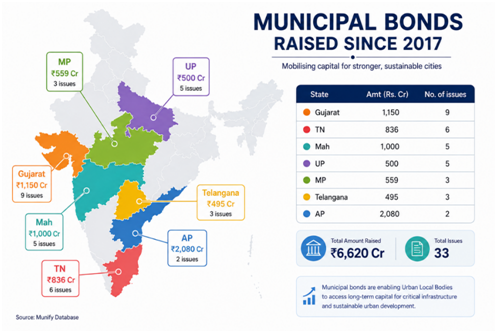
An analysis of over ₹6,000 Crores in municipal bond issuances since the SEBI framework revamp reveals an undeniable trend: Administrative harmony-not just city size-dictates capital market success.
Here is how the numbers stack up when you map SEBI debt statistics against regional governance structures:
- 55% - Unified Tri-Tier States: The overwhelming majority of capital is raised by cities where the Center, State, and Municipal Corporation are politically aligned (think Indore, Ahmedabad, Surat, and Lucknow).
- 45% - Non-BJP Aligned Megacities: Deep-pocketed tier-1 economic hubs (like Hyderabad and Chennai) bypass alignment because their local "own-tax revenue" engine is massive enough to secure institutional backing independently.
The Key Takeaway: For India's Tier-2 and Tier-3 cities to truly bridge their massive infrastructure funding gaps, financial health is only half the battle-achieving administrative synergy across governance layers is the ultimate gatekeeper to the market.